Expertise
I'm a KynoLogisch graduate, a member of the Berufsverband zertifizierter Hundetrainer e. V., and stay open and curious through regular further training.

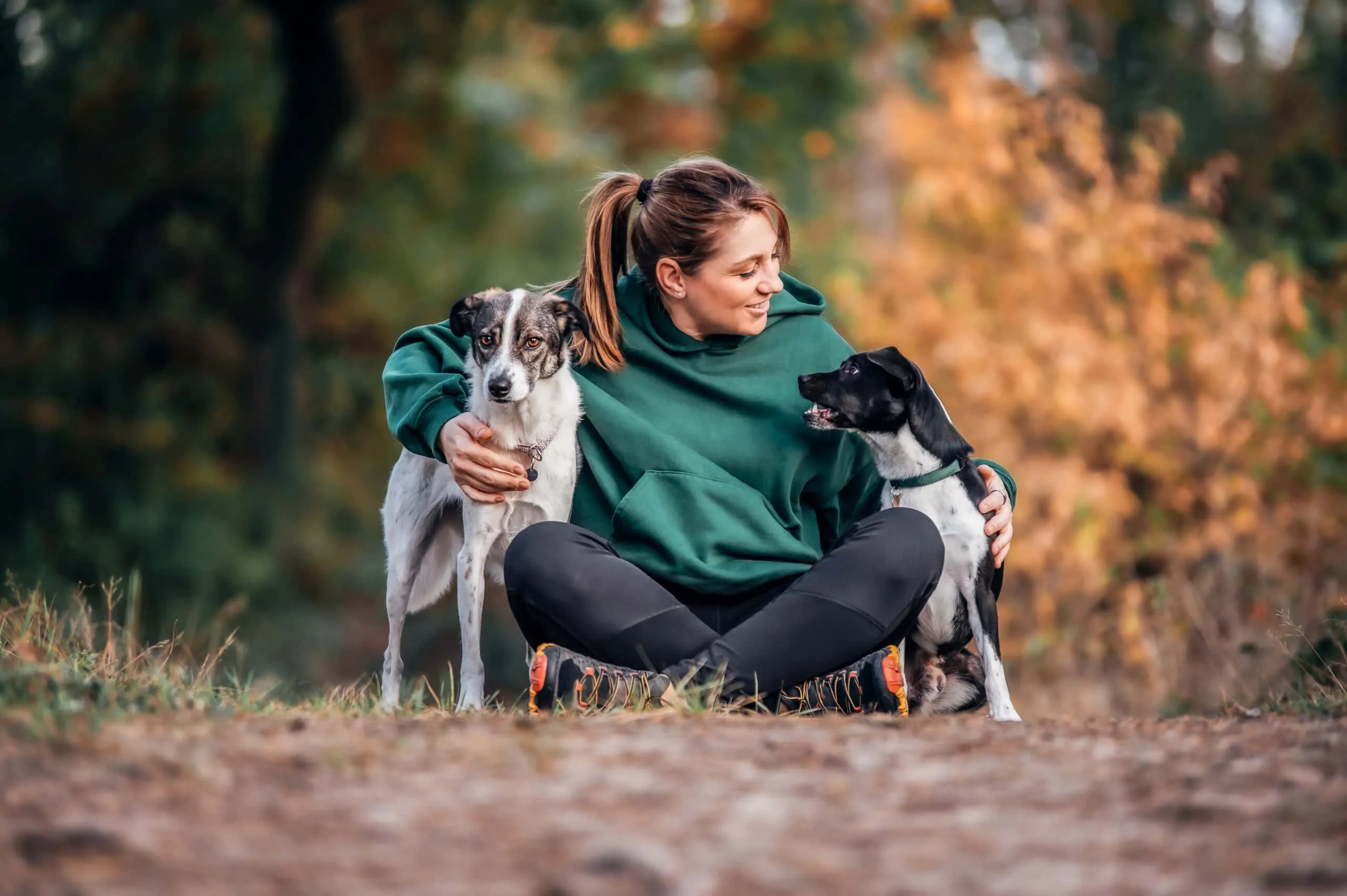
With self-employment as a dog trainer, I fulfilled a long-held dream. To me, there's nothing better than accompanying people and dogs as they grow together. Find out more about me, my qualifications and my own two dogs.
By the way: as my stepdad is American and I've worked in global companies for years, I speak English fluently.
About me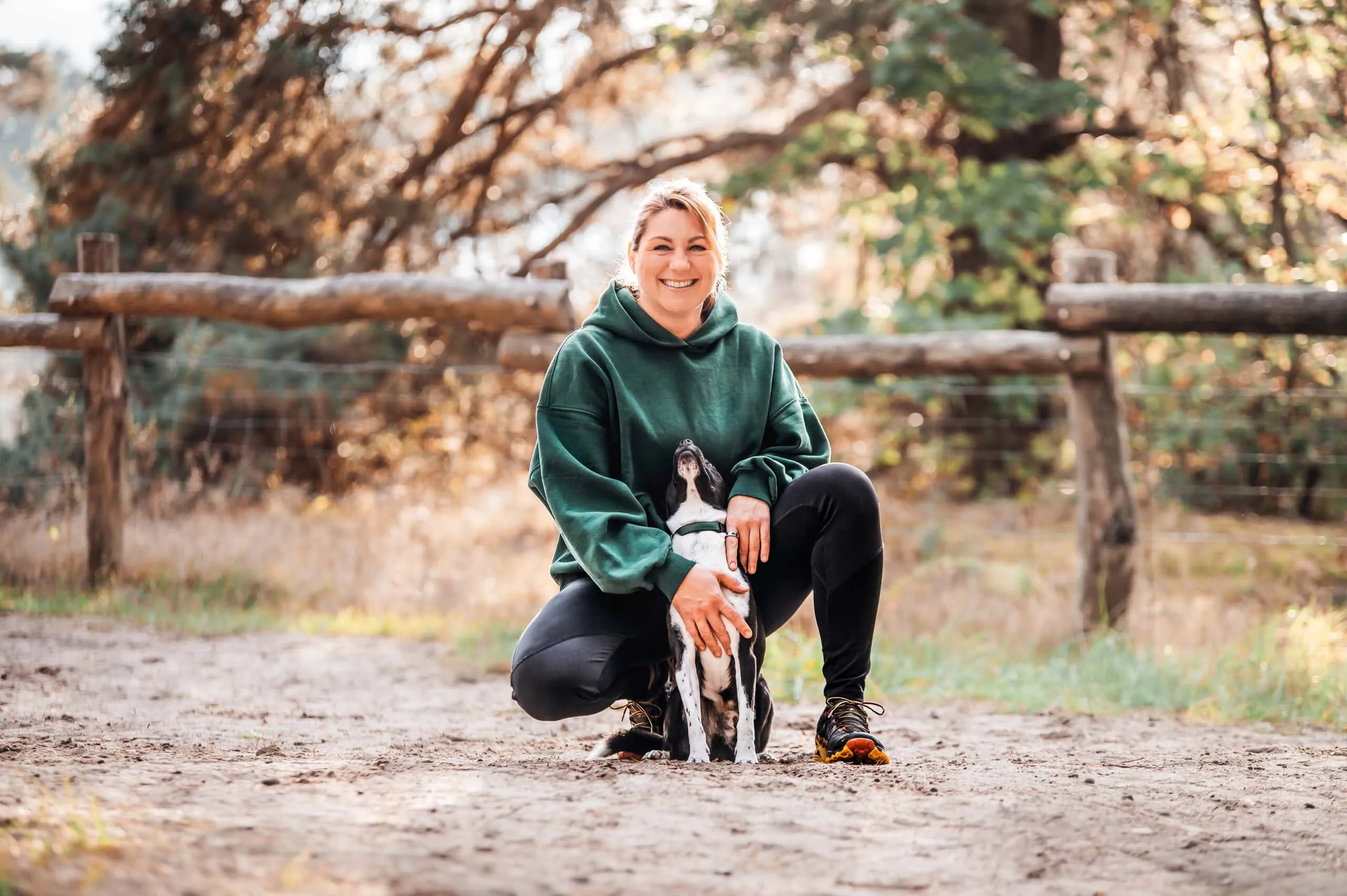
Just as individual as you and your dog are, so are your challenges. That's why you won't get one-size-fits-all training from me, but a training plan tailored to you and your dog.
The good news: there's no such thing as a hopeless case. Dogs with behavioural issues are very welcome.
Learn moreIf these values speak to you, you're in the right place with me.
I'm a KynoLogisch graduate, a member of the Berufsverband zertifizierter Hundetrainer e. V., and stay open and curious through regular further training.
It matters to me that you feel well looked after. Together we'll find the training path that fits you and your dog.
All dog breeds and all people are welcome with me – for more diversity and less narrow-mindedness.
In my individual training sessions, the focus is entirely on you as a human-dog team – with your individual questions, topics and challenges. In the group services, several teams work on the same topics together. Social walks and muzzle consulting are two more things close to my heart.
To my servicesSeveral times a year I run workshops and events in the Heidelberg area. Sometimes they're about specific focus topics, and sometimes they're simply about having fun with your own dog in a nice group of dog people.
To upcoming dates
My clients' satisfaction speaks for itself.
Feel free to see for yourself. I'm
always happy about new reviews.
Would you like me to work with you and your dog?
Great! I'm looking forward to your enquiry.
Not sure yet
whether I'm the right trainer for you?
On my blog you'll find articles on topics that matter to dog owners. Whether it's holiday planning with a dog, muzzle regulations, or dog-walking etiquette – there's bound to be something interesting for you. The blog is currently available in German only, but do take a look!
To the blog (German)
16 January 2026
Kennt ihr pauschale Aussagen wie „Das Problem liegt immer am anderen Ende der Leine“ oder „Dem muss man nur mal zeigen, wer der Chef ist!“?
Dog trainer Heidelberg – dog training, dog school and behaviour
As a dog school in Heidelberg I offer individual training (one-on-one dog training), group courses, social walks, seminars & workshops, and muzzle consulting. I work with puppies, adolescent dogs and adult dogs – from breeders as well as from animal shelters. Focus areas include: basic obedience, calmness and orientation, leash walking, fear & insecurity, aggression & leash reactivity, and stress behaviour, e.g. when left alone.
I completed my 2-year dog trainer training at KynoLogisch (including a final exam in theory and practice). A two-week internship at an animal shelter gave me valuable hands-on experience with dogs of different backgrounds and behavioural challenges. I've also attended numerous further training courses since 2023, which have enriched my expertise both in theory and in practice. Since 2026 I have been a member of the Berufsverband zertifizierter Hundetrainer e. V. Find out more about my qualifications here.
My own personal experience has shaped me a great deal too: I live with two rescue dogs myself who came with problem behaviour. That means I know the challenges many dog owners face not just in theory, but from my own everyday life.
Yes, at least one professional development course per year is firmly planned, so I stay up to date with modern training methods. Continuously expanding my expertise matters a great deal to me.
Yes, I've held this since December 2025 (Veterinary Office of the Rhein-Neckar-Kreis in Wiesloch).
You can write me an email (steffi@peach-hundetraining.de) or use the contact form. I'll get back to you within 24 hours to discuss the next steps.
Yes, by arrangement I also offer support between training sessions. How much support you need in everyday life is entirely up to you. Questions or uncertainties often come up especially when putting exercises into practice day to day. That's why you can reach out to me by email or WhatsApp between sessions if needed. If you'd like particularly intensive support, you can book an intensive coaching monthly package. In that case we stay in closer contact, so you get targeted support between training sessions too.
It's best to start training right after your dog moves in. Building the right foundation early lays the groundwork for as smooth a life together as possible. It also makes sense to find out in advance what matters most in the first weeks (and what doesn't). For this I offer a dedicated online consultation before your dog moves in.
My dog training is aimed at puppies & adolescent dogs, adult dogs, family dogs, and dogs with behavioural issues.
Both. You can book flexible single sessions as well as discounted package prices for Heidelberg, Mannheim or the surrounding area. For a longer training journey I offer attractive 3- and 5-session packages with a price advantage over individual sessions. If you'd rather stay flexible, you can book single sessions as needed.
Both. At my dog school I offer individual one-on-one training as well as group courses for dogs. In individual training, the focus is on your particular human-dog team and its individual challenges – for example leash walking, recall, being left alone, hunting behaviour or leash reactivity. In group courses we train with controlled distraction from other dogs and participants, which strengthens impulse control and the bond between dog and handler, among other things. In social walks, dogs learn appropriate ways to interact with their own kind while staying oriented towards their person.
I deliberately keep the groups in my dog courses small, so every human-dog team gets the best possible attention. Small groups mean higher training quality, a better training atmosphere, and room for individual feedback during the session.
I pay close attention to a suitable group composition, a small number of participants, and adapted exercises. My group sessions are structured and tailored to the participating human-dog teams. Your dog learns to focus on you despite other dogs being present. In the intensive courses, several participants work on a bigger topic area over several sessions, such as leash orientation or recall training.
As a mobile dog trainer in Heidelberg, I suggest a location that makes the most sense for you, your dog and your current training level. That can be at your home, in your familiar surroundings, or a suitable training spot in Heidelberg and the surrounding area. I also have my own training ground in Eppelheim.
Before every session we agree on the right meeting point in Heidelberg, Mannheim or nearby (e.g. Schwetzingen, Plankstadt, Eppelheim) individually.
Yes, I offer mobile dog training not just in Heidelberg but also in Mannheim and across the whole Rhein-Neckar-Kreis. I take appointments in Mannheim as well as in towns between Mannheim and Heidelberg, for example Schwetzingen, Oftersheim or Brühl.
Yes, home visits are possible. Behaviour and house rules at home form the basis for how your dog behaves outside your own four walls. That's why training in familiar surroundings is often especially useful, for example for topics like insecurity, barking, being left alone, visitors, or leash walking.
Yes, I advise on suitable training locations and nice walking routes, helping you settle into a new environment.
Yes, for certain topics online training is possible – for example to go over the basics before your dog moves in, or if you're travelling with your four-legged companion and run into challenges along the way.
No, your dog doesn't need to know specific basic commands like "sit" or "down" to start training. I meet every human-dog team exactly where they currently are, and we build up the fundamentals together step by step. Some services or group courses do require a certain level of prior knowledge or training – you'll find notes on that in the respective course descriptions.
An initial consultation consists of three parts: preparation, an analysis session, and then creating the training plan. Before the initial consultation you'll receive an intro form from me to prepare. In the consultation itself I take plenty of time, ask targeted questions and observe various situations from your everyday life. Together we define a realistic, long-term training goal and discuss the next steps. Afterwards I put together an individual training plan, which is then implemented step by step in the following individual sessions.
At the start of an individual training session, we discuss the goal for that session and look at how putting the previous exercises into practice went. I then assess your dog's current training level and adjust the exercises if needed. Depending on progress and development, I decide individually whether to increase the difficulty of existing exercises or start a new one.
A unit within an individual session lasts 60 minutes. For the initial consultation I plan 90 minutes.
First positive changes are often visible after just a few training sessions. However, how quickly and how lastingly progress happens depends on various individual factors, above all consistent implementation in everyday life and regular repetition. Every human-dog team learns at its own pace.
Yes, after every training session you'll receive concrete exercises and individual "homework" for your everyday life. These exercises help consolidate what you've learned between sessions and integrate it lastingly into daily life.
My dog training isn't based on rigid methods or a fixed "one-size-fits-all" approach. Instead, an individual analysis of dog and human is at the centre. Every team has its own history and prior experience, which I factor into the training plan. That's why I choose different training approaches that fit the particular team and their current training level.
Yes, a fairly structured approach to exercises matters to me. That's why I work with positive reinforcement, to teach the dog which behaviour is desired. Once a dog reliably understands a behaviour, the difficulty is gradually increased so what's been learned stays reliably accessible in everyday situations and under distraction too. In the sense of learning theory, forms of punishment within operant conditioning can also play a role here. Violence is never part of my training, and I explicitly distance myself from it.
Yes, training will improve the quality of your relationship. Over the course of training, the human increasingly becomes a reliable social partner through shared successes, clear communication and a better understanding of canine behaviour – which leads to a better relationship in the long run.
I look at problem behaviour in dogs analytically. Together with the owner, I take a close look at why the dog shows a particular behaviour and what's causing it. Only once the motivation and triggers behind a behaviour are understood can a lasting training approach be developed.
I'm happy to support you in training dogs with a strong hunting drive. If a dog reacts strongly to wildlife, movement or scents, reliable orientation towards its person is the most important foundation for a safe, relaxed walk. We work together to direct your dog's attention more towards you and gradually improve recall, impulse control and responsiveness.
I'm happy to support you with training against leash reactivity and other unwanted on-leash behaviour. The causes can vary widely – for example insecurity, frustration, bad experiences, being overwhelmed, or a lack of orientation towards the person. That's why I don't develop a standard plan, but an individual training approach.
Your dog should learn to walk relaxed on the leash and stay better oriented towards you even under distraction. In leash-walking training we work with clear routines and understandable structures, establishing different modes: an orientation mode, in which your dog works attentively with you, and a free-time mode, which allows more room for sniffing and exploring. That way, pulling on the leash will soon be a thing of the past.
Yes, I'm happy to support you with training for being left alone. In the initial consultation I analyse the possible causes of your dog's discomfort together with you and then create a suitable training plan.
Yes, I support you in building a reliable recall. The goal of the training is for your dog to stay responsive even under distraction and reliably respond to your recall – for more freedom on walks and more peace of mind in everyday life.
Dogs with fearful behaviour and insecurities can learn to overcome them. We work in small steps and with controlled stimuli. The training should give your dog courage, enable positive experiences, and encourage alternative behaviours – without overwhelming it.
I'm happy to support you with training around aggressive behaviour or difficult dog encounters. Aggressive behaviour in dogs can have various causes – for example insecurity, fear, frustration, being overwhelmed, or unfavourable learning experiences. In training I work with both targeted management and suitable training measures, to reduce risky situations in everyday life and build up alternative behaviours.
For dog training you need a regular leash, a well-fitting collar and a suitable harness. You should also bring suitable rewards, for example treats or your dog's favourite toy. For certain training areas (e.g. recall training, range training or anti-hunting training) I additionally recommend a long line.
I decide that on a case-by-case basis – most dogs don't need a muzzle. That said, it's generally a good idea for every dog to own a properly fitting muzzle. That's why I offer muzzle consulting as part of individual training. For a well-fitting muzzle, I advise you on potentially suitable models and adjust the shape so it sits comfortably on your dog's snout.